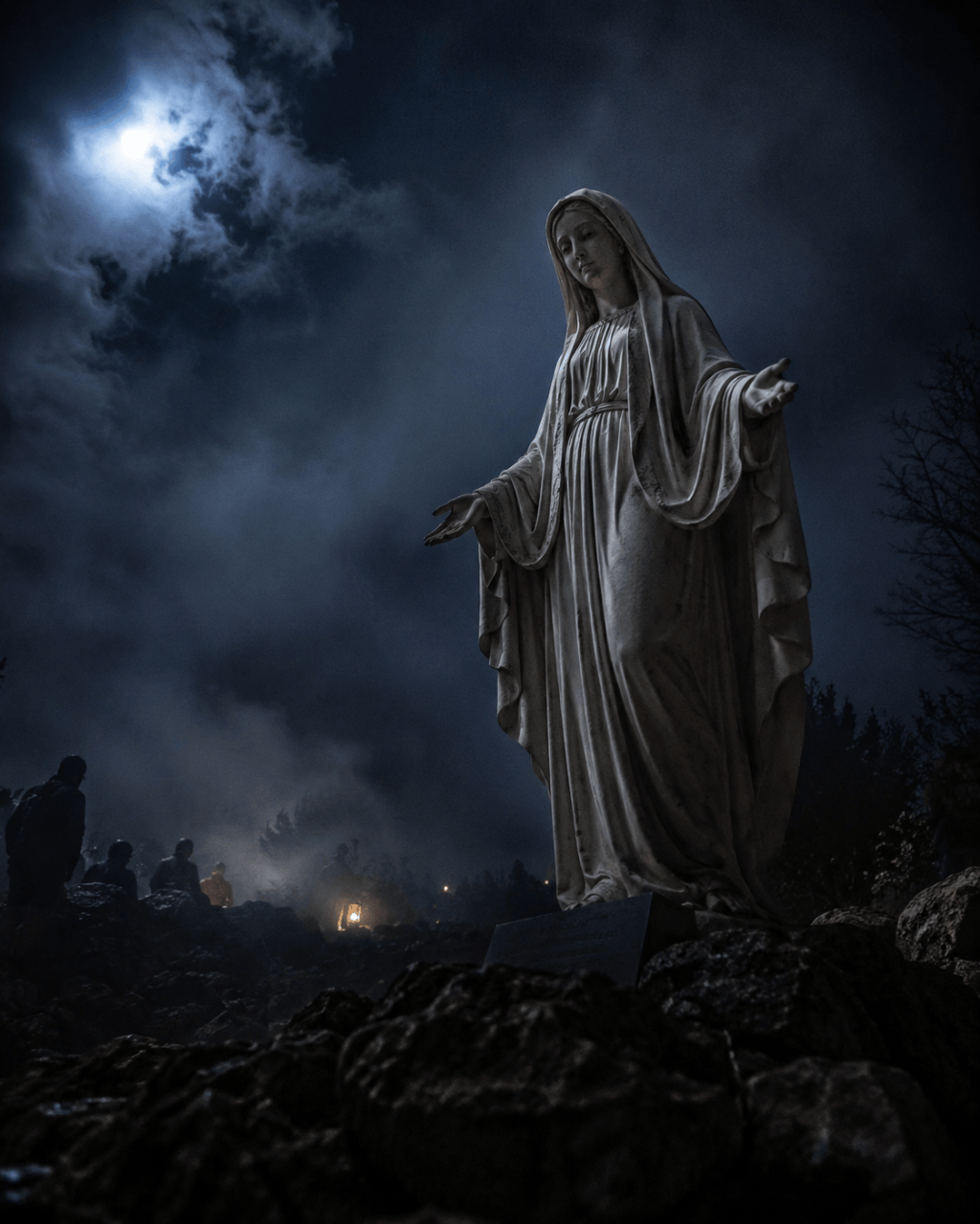
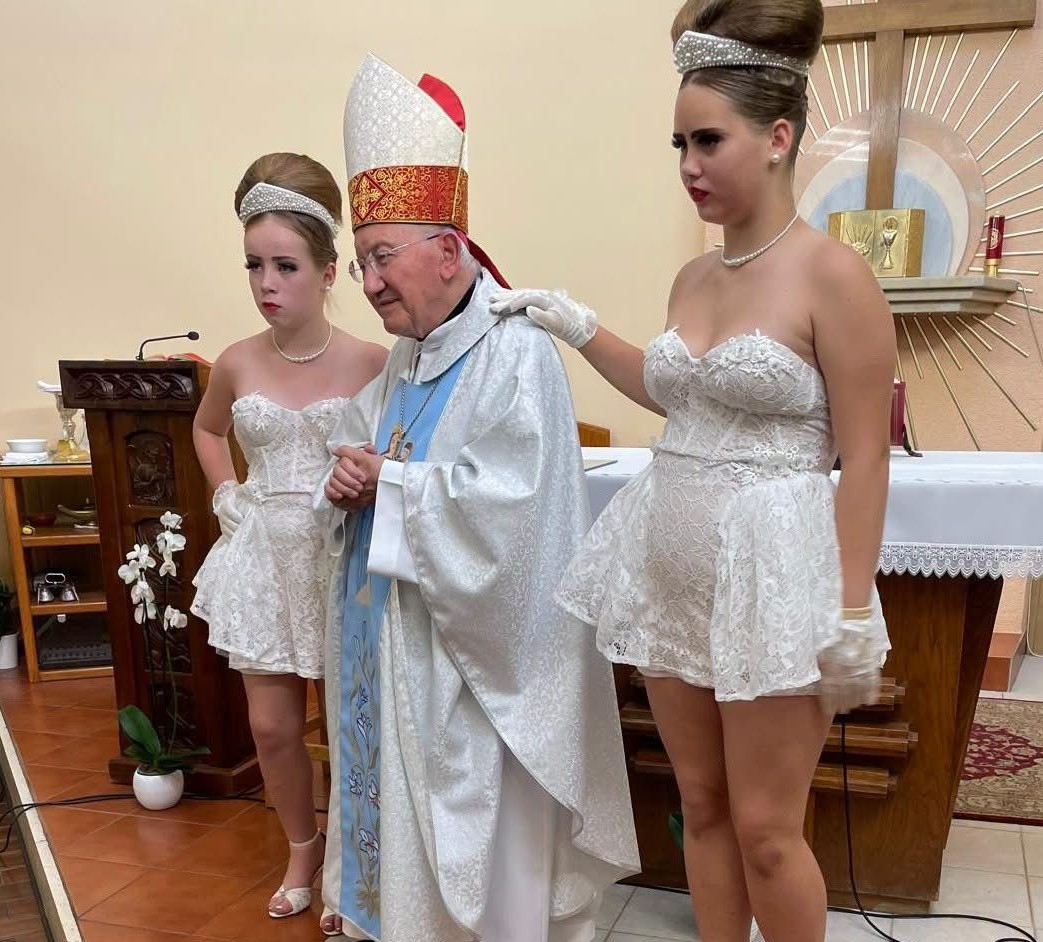
The images you see here were taken during a celebration held in recent days at St. James Parish in Medjugorje.
The photographs — which were not created with Artificial Intelligence — are authentic and show the administration of the Sacrament of Confirmation to the two young women pictured.
Several sources, including some that tried to offer an explanation for what happened, confirmed the event and the facts.
The two young women are Irish. They are Irish Travellers, members of an indigenous ethnic minority originating in Ireland and culturally distinct from Roma and Sinti communities.
The Confirmation was administered by Archbishop Aldo Cavalli, the special Apostolic Visitor for the parish of Međjugorje, who is approaching his eightieth birthday.

The celebration took place in the Adoration Chapel inside the parish complex, where the Blessed Sacrament is present and where pilgrims gather every day to pray.
In these photographs, the two young women are wearing their traditional dress, the clothing they wear during celebrations within their community.
But the point is that the administration of the Sacrament of Confirmation is not simply a party. It is a liturgical celebration. The Catholic Church is universal and respects local cultures. The Second Vatican Council, in the Constitution Sacrosanctum Concilium, established that the Church does not seek to impose rigid uniformity in the liturgy where matters of faith are not at stake, and it allows room for the customs of different peoples.
However, when traditional local dress appears objectively revealing by the standards of a liturgical celebration, it is often adapted: shawls, cloaks or tunics may be added so that the colors and symbols of a tradition can be preserved without detracting from the respect due to the sacrament.
Without indulging in moralism, prudishness or the usual accusation of “rigidity” — and assuming the good intentions of the celebrant, Archbishop Cavalli — it is nevertheless legitimate to ask whether those clothes were truly appropriate to the place, the occasion and, above all, the celebration of a sacrament.

I have received many messages from pilgrims and faithful who were scandalized and, above all, concerned about what this important Marian place of devotion represents.
The issue is not about measuring centimeters of fabric or turning a church into a place governed by a dress code. In my view — and perhaps I am wrong — it is more simply a matter of decorum, respect and appropriateness. It may also be a matter of responsibility on the part of those organizing a celebration, who could discreetly and sensibly point out when clothing appears out of keeping with the sacred nature of the moment.
I am not a liturgy expert and I do not claim to lecture anyone. But common sense suggests a simple consideration: if someone entered a mosque, a synagogue or another place of worship where specific forms of respect are required wearing similar clothing, the matter would hardly be dismissed as an irrelevant detail.
Am I wrong?
P.S. I repeat: THE PHOTOGRAPHS ARE AUTHENTIC.
Originally published in Italian on Il Segno di Giona on September 4, 2026.
For the broader context, see the Vatican investigation into Medjugorje
READ THE FULL VATICAN DOSSIER
David Murgia’s investigation into the confidential Vatican documentation on Medjugorje is available in three editions on Amazon.com.
ABOUT THE AUTHOR
David Murgia is an Italian journalist, author and member of the Pontifical International Marian Academy. His investigations have brought to light the world of self-styled holy men and false healers. The New York Times described him as a “formidable investigator of the sacred.” A commentator for Rai and Mediaset, he was the first journalist in the world to publish in full the secret Vatican dossier on Medjugorje. He lives and works in Rome.

